Hospitality Furniture Manufacturers: China’s Contract Sector
Hospitality furniture manufacturers occupy a distinct niche within the broader furniture industry. Unlike residential or retail furniture production, hospitality contract manufacturing requires adherence to commercial durability standards, project-specific specification management, and delivery coordination that aligns with hotel construction schedules. Choosing the wrong manufacturer for a hospitality project does not just mean lower-quality furniture — it can mean missed opening dates and brand standard violations.
This guide breaks down what separates a genuine hospitality furniture manufacturer from a general furniture producer, how to evaluate suppliers for hotel and resort projects, and what buyers can expect from the Chinese contract furniture sector that currently serves the majority of international hospitality developments.
What Defines a Hospitality Furniture Manufacturer
The term is used loosely in the market, and that creates real risk for buyers. A manufacturer producing bedroom furniture for retail consumers is not necessarily qualified to produce hotel guestroom casegoods to brand standards. The differences go beyond the finished product.
True hospitality furniture manufacturers build their entire operation around the requirements of commercial projects. This means production facilities designed for batch manufacturing at scale — not piece-by-piece production. It means quality management systems that document defect rates, maintain inspection records, and have formal non-conformance resolution procedures. It means project managers who understand FF&E procurement cycles, can navigate brand standards, and know how to communicate across the language and time zone gap between a Foshan factory and a project team in Mexico City or Bogotá.
Critically, it means commercial-grade construction. Hotel furniture is subject to daily use by guests who are often less careful with property than they would be in their own homes. A nightstand that looks identical to a residential product may fail structurally within 18 months under hotel use conditions. Hospitality-specification furniture uses heavier gauge hardware, reinforced joinery, commercial-grade fabrics with higher rub counts, and surface finishes engineered for abrasion resistance — none of which are visible in a photograph or showroom display.
The Foshan Contract Furniture Cluster
Foshan, in Guangdong Province, is the world’s most significant hospitality furniture manufacturing cluster. The city and its surrounding districts — Shunde, Nanhai, Lecong — contain thousands of furniture manufacturers, ranging from small specialist workshops to large-scale export-focused contract operations employing hundreds of workers.
The scale of this cluster creates structural advantages that no other manufacturing region can replicate. Material suppliers, hardware manufacturers, fabric and leather wholesalers, and specialist finishing operations are all concentrated within the same ecosystem. A Foshan contract furniture manufacturer can source veneer, lacquer, brass hardware, commercial-grade fabric, and upholstery foam from suppliers within a 30-kilometre radius, enabling short iteration cycles on samples and consistent quality control across large orders.
Foshan factories currently supply FF&E for hotel brands operating in over 80 countries. The upper tier of manufacturers in this cluster meet or exceed the quality standards required by Marriott, IHG, Hilton, and comparable international hotel brands — not as an aspiration, but as a documented, verifiable operational reality.
Categories of Hospitality Furniture: What Manufacturers Specialise In
Hospitality projects require furniture across multiple categories, and manufacturers in Foshan generally specialise in one or two primary product types rather than producing everything with equal quality.
Guestroom Casegoods
Casegoods — bed frames, nightstands, desks, wardrobes, dressers, and luggage benches — represent the highest volume and highest value category in most hotel FF&E packages. Casegood manufacturers focus on precise dimensional accuracy, consistent finish replication across large batches, and structural engineering that meets commercial loading requirements. Top Foshan casegood manufacturers produce for 5-star hotel brands and can work to tight dimensional tolerances specified by international interior design firms.
Upholstered Seating
Upholstered seating — lounge chairs, sofas, banquette seating, dining chairs, accent chairs — is a distinct manufacturing discipline from casegoods. Seating manufacturers specialise in frame construction (kiln-dried hardwood or metal), spring and cushion engineering, fabric and leather selection, and the complex pattern-matching required for high-specification upholstery. Buyers sourcing both casegoods and seating for a single project often work with two separate manufacturers to get best-in-class quality in each category.
F&B and Public Space Furniture
Restaurant, bar, and lobby furniture for hospitality projects has specific requirements. Dining chairs in F&B venues need higher durability specifications than guestroom seating — they are moved, stacked, and used continuously across multiple seatings per day. Lobby furniture needs to project the property’s design identity while withstanding high traffic. Manufacturers specialising in F&B and public area furniture understand these requirements and build accordingly.
Custom and Decorative Pieces
High-end hospitality projects include custom decorative furniture — console tables, feature headboards, custom bar counters, bespoke reception desks — that require specialist craftsmanship beyond standard production runs. A small number of Foshan manufacturers focus on this high-complexity, low-volume work, and they are the appropriate choice when the design requires genuinely custom fabrication rather than specification-modified standard production.
Evaluating a Hospitality Furniture Manufacturer: A Practical Framework
When assessing a manufacturer for a hospitality project, the evaluation should go well beyond the showroom visit. A six-point framework helps structure the assessment:
- Hospitality project references: Ask for a list of completed projects with property names, brand affiliations, and room counts. Verify at least two references by contacting the project’s procurement manager or interior designer directly.
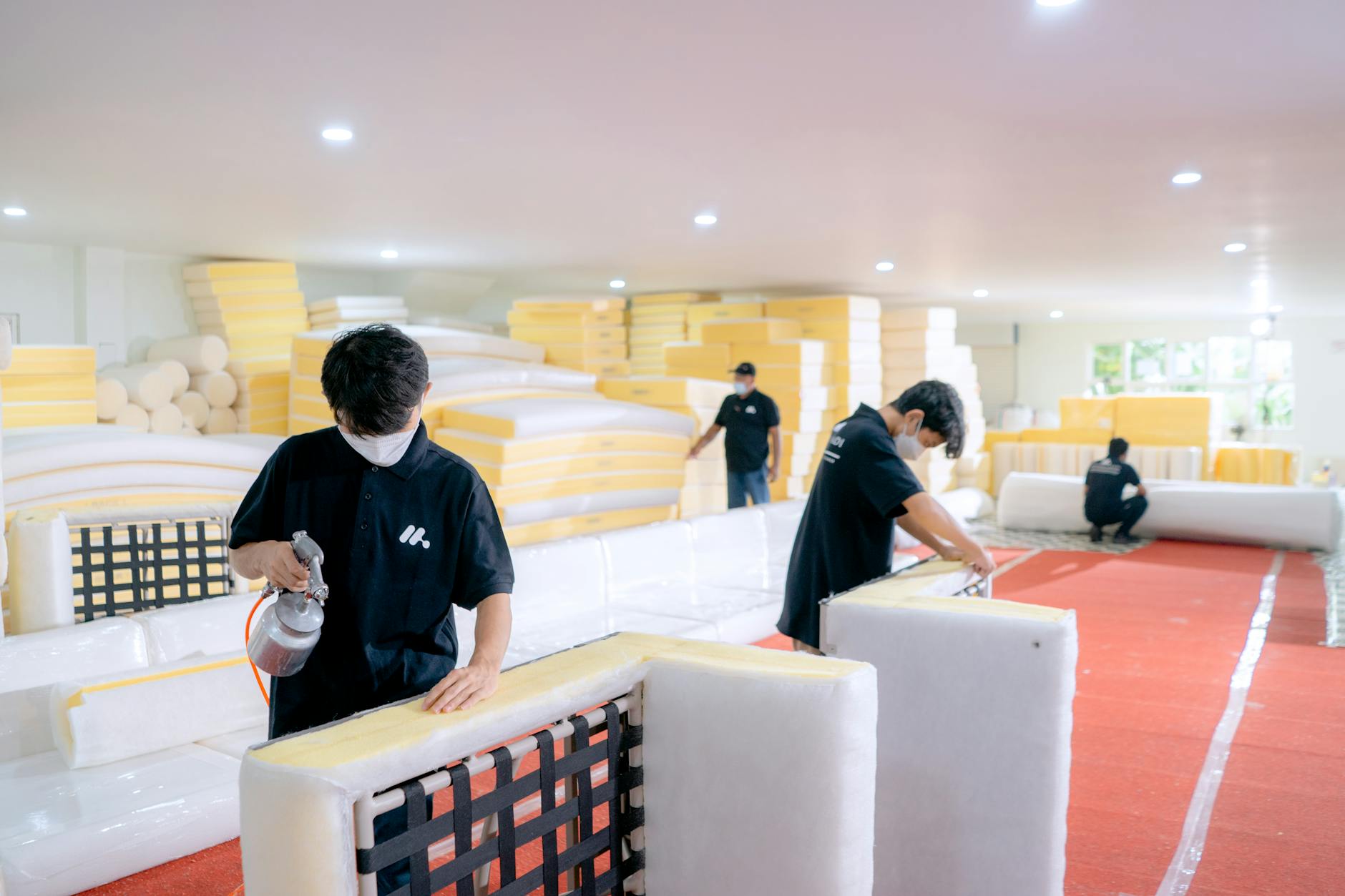
- Production facility inspection: Visit the production floor, not just the showroom. Look for organised material storage, clearly marked production stages, dedicated finishing areas with controlled humidity and temperature, and QC workstations at relevant production points.
- Commercial certification documentation: Request ISO 9001 certificate, BIFMA compliance test reports for structural components, and any brand-specific certifications relevant to your project (e.g., Marriott’s furniture specification compliance documentation).
- Sample production capability: Request that the manufacturer produce a finish sample panel for your project’s specified materials within two weeks. The speed and quality of this response is a reliable indicator of production capability and organisational efficiency.
- Project management team: Meet the person who will manage your account. Assess their English capability, their familiarity with international hotel brand standards, and their experience managing projects of similar size and complexity to yours.
- Financial stability: For orders above USD 500,000, request three years of financial statements or a bank guarantee. A manufacturer that cannot provide financial assurance may be taking on more work than their cashflow can support — a significant delivery risk for projects with tight opening timelines.
Lead Times and Project Scheduling
Lead time management is where hospitality furniture procurement most often creates project risk. Hotel development timelines are unforgiving — a 60-day furniture delivery delay can push opening by a month or more, with revenue implications that dwarf the furniture cost.
Typical lead times from a Foshan hospitality furniture manufacturer for a hotel project order:
- Sample production: 3 – 6 weeks from specification confirmation
- Sample approval and revision: 2 – 4 weeks (depending on client review speed)
- Bulk production (100 – 300 rooms): 8 – 12 weeks from approval
- Pre-shipment inspection: 1 – 2 weeks
- Sea freight to Latin America: 4 – 6 weeks depending on destination port
- Customs clearance and local delivery: 2 – 4 weeks
Total calendar time from project kick-off to furniture installed on-site: typically 24 to 36 weeks. Buyers who begin FF&E procurement less than six months before the target opening date are already behind schedule.
Price vs. Quality Trade-offs in the Hospitality Manufacturing Sector
The hospitality furniture manufacturing market in China operates across a wide quality and price range. Buyers need to understand what they are buying at each price point.
At the lower end of the market, manufacturers produce furniture that looks acceptable in photographs and in the showroom but underperforms on commercial durability metrics. Board materials may be lower-density particleboard rather than MDF; joinery may rely on staples and glue rather than properly fitted mortise-and-tenon or dowel construction; fabrics may carry rub counts below the 30,000 cycles typically specified for commercial seating. This furniture will begin showing wear within 18 months of hotel opening and may require replacement within four years — a total cost that often exceeds the premium charged by better manufacturers in the first place.
The top tier of Foshan hospitality manufacturers produces furniture that lasts the full 8 to 12-year renovation cycle common in hotel properties. The price premium over mid-market manufacturers is typically 30 to 50 percent on an ex-factory basis. When lifecycle cost is considered, the better-specified furniture is almost always the lower total cost option.
Working with Chinify to Source Hospitality Furniture
Chinify works exclusively with hotel developers, interior design firms, and real estate teams sourcing commercial furniture from China. Our team is based in Foshan and maintains direct relationships with vetted hospitality furniture manufacturers across the casegood, seating, and F&B furniture categories.
We manage the full sourcing cycle: factory qualification, specification review, sample coordination, production oversight, pre-shipment inspection, and logistics to your destination port. Our clients are typically working on hotel and resort projects from 50 to 500 rooms, with FF&E budgets of USD 500,000 to USD 8 million.
If you are planning a hotel project and want to understand what the right hospitality furniture manufacturers in China can deliver for your specification and budget, contact Chinify to discuss your project.