How to Import Furniture from China: The 2026 Guide for Hotel & Residential Projects
Importing furniture from China can cut the cost of a hotel, residential or commercial furniture package significantly, but only if the whole chain is managed: specification, supplier choice, samples, payment, quality control, shipping and customs. Most problems buyers run into do not come from the factory floor. They come from vague specifications, quotes that are not comparable, missing inspections and landed-cost surprises at the port.
This guide walks through the full process step by step, from the first brief to furniture delivered on site. It is written for developers, hotel owners, interior designers and procurement teams buying for projects in the United States, Mexico and Latin America.

When importing furniture from China makes sense
China is not the right answer for every order. It works best when:
- The scope is a package, not a few pieces. Dozens of identical guestrooms, a residential tower, a restaurant fit-out or a full villa.
- You need custom work. Sizes, materials and finishes made to your drawings, which local suppliers often cannot produce at the same price or scale.
- You have time. A custom package usually needs 4 to 6 months from approved drawings to delivery. If you need ten chairs next week, buy locally.
For a quick side-by-side of costs, quality and lead times, see our comparison of China vs. local factories for hotel FF&E.
Step 1: Build the specification before you ask for prices
Start from a room schedule, not a catalog. List every area (guestroom types, lobby, restaurant, terraces), every item in each area, the quantity, the dimensions and the finish. Add drawings, reference photos or a moodboard for anything custom.
The more precise the brief, the more comparable the quotes. A factory that receives “a walnut sofa, about 2 metres” will price something different from the factory next door. A factory that receives dimensions, frame material, foam density, fabric reference and finish code will price the same product as everyone else.
Step 2: Decide where you will buy
There are four common routes. Each has a different balance of price, control and effort:
| Route | Works well for | Watch out for |
|---|---|---|
| Online marketplaces (Alibaba, Made-in-China) | Standard items, small test orders | Many listings are trading companies; quality varies between sample and production |
| Direct from a factory | Large repeat orders in one category | One factory rarely makes everything in a project; you manage QC and consolidation yourself |
| Furniture markets (Foshan, Lecong) | Seeing many products and factories in a few days | Showrooms are often resellers; you need to reach the real manufacturer |
| Sourcing agent | Multi-category projects, custom work, first-time importers | Check how the agent is paid and whether it is independent from factories |
Most project furniture in China is made in and around Foshan (Guangdong province), especially the Lecong, Longjiang and Shunde areas, where hundreds of specialised factories sit within short driving distance. If you plan to visit, read what to know before visiting Foshan furniture factories. If you are weighing an agent, see what a China furniture sourcing agent does.

Step 3: Compare quotes like for like
The cheapest quote is often missing something. Before you compare prices, check that every quote states:
- Materials for frame, panels, veneer or solid wood, metal, stone and fabric
- The finish process and colour reference
- Confirmed dimensions and drawings
- Export packing (and whether it is included)
- Sample cost and any mould or development fees
- Production lead time, counted from which approval
- The Incoterm (EXW, FOB, CIF…) and the port
- Payment terms
If one quote is far below the others, ask why before celebrating. Minimum order quantities also vary: standard products can start from 5 to 10 pieces per item, while fully custom development usually needs 20 to 50 pieces. Our guide to custom furniture MOQ explains how factories set them.
Step 4: Approve samples before production
Samples are not a formality. They show how the factory reads your design, how it builds and how the finish really looks. Typical timings:
- Standard product with a size or finish change: 2 to 3 weeks
- New design: 3 to 6 weeks
For custom hotel furniture, approve finish panels first, then a full prototype of each key item. Photograph and sign off the approved sample: it becomes the quality standard for production and inspection.

Step 5: Agree payment terms that protect you
The usual structure is a 30% deposit when the purchase order is confirmed and the balance before shipment, once the pre-shipment inspection has passed. For very large orders, a letter of credit adds security. Avoid paying the full amount before production, and tie the balance to inspection approval rather than to a date.
Put the essentials in the purchase order: approved sample reference, delivery date and tolerance, inspection rights, packing standard and what happens if the goods do not match the sample.
Step 6: Control quality during production, not after
Once a container leaves China, fixing problems becomes slow and expensive. Plan three checks:
- Materials inspection before cutting starts: wood moisture, board grade, fabric and hardware against the specification.
- In-production inspection at 30–50% completion: construction, joinery, upholstery and finish consistency.
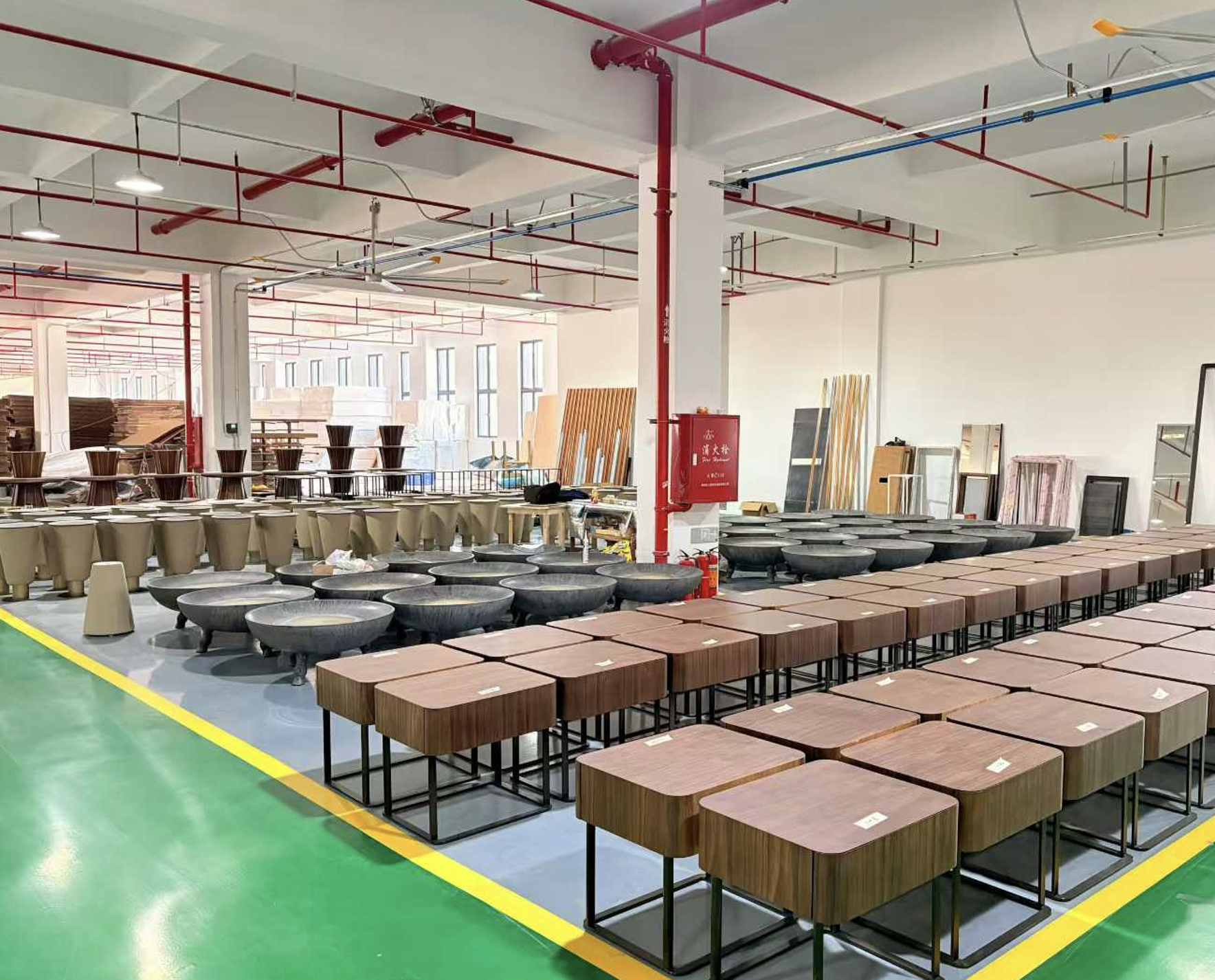
- Pre-shipment inspection of finished and packed goods: dimensions, finish against the approved sample, function, quantities and packing, with photos and a signed report.
Step 7: Choose the right Incoterm
The Incoterm defines where the supplier’s responsibility ends and yours begins. The ones you will see most:
| Incoterm | Supplier covers | You cover |
|---|---|---|
| EXW (Ex Works) | Goods ready at the factory | Everything else, including export clearance in China |
| FOB (Free On Board) | Factory, local trucking, export clearance, loading at the Chinese port | Ocean freight, insurance, import customs, duties and delivery |
| CIF | FOB plus ocean freight and insurance to your port | Import customs, duties, port fees and delivery |
| DDP | Everything to your door, duties included | Very little, but you have less visibility on costs |
For project buyers, FOB is usually the clearest basis for comparing suppliers, because it separates product cost from logistics cost. Chinify quotes FOB Foshan for this reason.
Step 8: Ship it
Project furniture normally travels by sea. A 20-foot container holds roughly 25 cubic metres of usable space and a 40-foot container roughly 55; if your order is smaller than a container, it can ship as LCL (shared container), which is cheaper upfront but adds handling and time. Ocean transit from South China typically takes around 2 to 3 weeks to the US West Coast and the Pacific ports of Mexico, and longer to the US East Coast, the Caribbean and South America, plus time for booking, port handling and inland transport.
Use a freight forwarder that handles furniture regularly, and insure the shipment. Ask the factory for a loading plan so the container is used efficiently and fragile pieces are protected.
Step 9: Clear customs and pay duties
Furniture falls mainly under chapter 94 of the Harmonized System: 9401 for seats and sofas, 9403 for other furniture such as tables, cabinets and beds, and 9404 for mattresses. The exact code determines the duty rate, so classify every item with your customs broker before you order, not when the container arrives.
- United States: besides the normal duty, many furniture codes of Chinese origin carry additional tariffs that have changed several times in recent years.
- Mexico: you need to be registered as an importer (padrón de importadores) or use one, and clearance goes through a licensed customs broker (agente aduanal). Import duty, 16% VAT and customs processing fees apply, and rates for goods from countries without a trade agreement have been revised recently.
- Colombia and the rest of Latin America: requirements differ by country; see our Colombia import guide and Mexico import guide.
Because tariff rates change, always confirm the current rate for your HS codes with a licensed broker at the time you place the order.
Step 10: Calculate the real landed cost
Compare suppliers, and compare China with local options, on landed cost rather than on factory price:
Landed cost = product price (FOB) + ocean freight + insurance + import duties + taxes + broker and port fees + inland delivery + installation.
Add a contingency for sample rounds and for the time between deposit and delivery. A package that is 40% cheaper at the factory may still be the best choice after all of this, but you should know the number before you commit.
A realistic timeline
| Stage | Typical duration |
|---|---|
| Brief, supplier selection and quotes | 2 to 4 weeks |
| Samples and prototypes | 2 to 6 weeks |
| Production, standard products | 30 to 45 days |
| Production, custom products (after sample approval) | 45 to 75 days |
| Production, orders above 1,000 pieces | 90 to 120 days |
| Inspection, packing and loading | 1 to 2 weeks |
| Ocean freight, customs and inland delivery | 3 to 8 weeks depending on destination |
Plan backwards from your opening date and leave a buffer. The most common reason furniture arrives late is not production; it is approvals that took longer than planned.
Common mistakes to avoid
- Approving production without a signed sample
- Comparing quotes with different materials, packing or Incoterms
- Paying the balance before the pre-shipment inspection
- Classifying HS codes and checking duties only after shipping
- Splitting a project across many unrelated factories with no one coordinating finishes and loading
Frequently asked questions
Is it cheaper to import furniture from China?
For project volumes and custom pieces, usually yes, even after freight and duties. For a few standard items needed quickly, local suppliers are often the better choice. Compare on landed cost.
Can I import furniture from China without a company?
That depends on your country’s rules for importers. In Mexico, for example, you need to be registered in the importers’ register or use a registered importer. Ask a customs broker before you order.
How long does it take to import furniture from China?
For a custom project package, plan on roughly 4 to 6 months from approved drawings to delivery on site. Standard products can be faster.
What is the minimum order to import furniture from China?
Standard products can start from 5 to 10 pieces per item. Custom development usually needs 20 to 50 pieces. Filling at least one container keeps freight cost per piece reasonable.
Do I need a sourcing agent?
Not always. For a single category from one factory, you can buy direct. For multi-category projects, custom work or a first import, an agent in China saves time and reduces risk through supplier vetting, QC and consolidation.

Importing furniture from China with Chinify
Chinify is a furniture sourcing agency based in Foshan, with a sales office in Mexico City. We turn your drawings and room schedules into specifications factories can build, match each category to the right verified factory, run samples and three-stage quality control, and prepare export packing and documents. We quote FOB Foshan so you can compare clearly, and we work in English, Spanish and Mandarin.
Browse the furniture catalog, see how our Foshan factory tours work, or send us your project. We reply within 24 hours.